
What Should You Expect From an Outside Sales Performance Consultant?
Sales-performance insights for owners and executives who want to understand what is really limiting growth.
Hiring an outside sales-performance consultant is a significant business decision.
The company is not simply purchasing advice.
It is bringing in an outside resource to examine an important part of the business and potentially influence processes, management practices, sales-team performance, and investment decisions.
That means the engagement should have a clear purpose, defined scope, measurable work, and a practical path from findings to action.
Start With Diagnosis
A credible engagement should begin by understanding the organization.
That means examining:
- Business objectives
- Sales objectives
- Current performance
- Management concerns
- Sales organization
- Existing processes
- Available data
- Lead sources
- Sales systems
- Areas where management believes opportunities may exist
The consultant should not begin by assuming the answer is training, more salespeople, a new CRM, more advertising, or some other predetermined solution.
The solution should emerge from the diagnosis—not the other way around.
A diagnostic approach is common among established sales-performance consulting firms, particularly where the objective is to identify whether the performance gap comes from process, strategy, management, technology, or individual capability. (Performance Methods, Inc)
Expect Evidence-Based Priorities
A sales operation can have numerous areas that could theoretically be improved.
That does not mean all of them deserve equal attention.
A useful engagement should identify:
- What is working
- Where opportunities are being lost
- What issues have the greatest potential impact
- What should be addressed first
- What should not be prioritized
- What resources are required
This keeps the work focused on business impact rather than creating a long list of recommendations that management may never implement.
Expect Clear Responsibilities
Recommendations should not exist in a vacuum.
For each significant action, management should understand:
- What needs to be done?
- Why does it need to be done?
- Who is responsible?
- What resources are required?
- How will success be measured?
Those questions turn recommendations into an executable plan.
Know Whether You Are Buying Advice or Implementation
This is one of the most important distinctions when comparing engagements.
Some consulting engagements are primarily assessments. The consultant examines the organization, identifies issues, and delivers recommendations. Management then handles implementation internally.
Other engagements include hands-on implementation.
In that model, the outside resource remains involved in putting recommended changes into operation, working with leadership and employees, monitoring results, and making adjustments.
An assessment can identify what needs to change.
Implementation is what turns those findings into operating changes.
Neither model is appropriate for every company. The important thing is knowing exactly which model you are purchasing.
Expect Measurable Performance Management
Sales-performance work should ultimately connect back to results.
That does not mean promising a particular percentage increase.
It means establishing appropriate measures and monitoring what happens as changes are implemented.
A useful executive framework is:
- Where are we?
- What have we found?
- What are we doing about it?
- Who is responsible for what?
- What results are we getting?
These questions keep the engagement connected to actual business performance.
Expect Transparency About What Is—and Is Not—Included
A professional engagement should clearly define its scope.
If the engagement includes assessment but not implementation, that should be stated.
If implementation is included, the company should understand the extent of that involvement.
If third-party costs such as advertising, website development, technology, or specialized production are separate, those costs should be identified separately.
Clear scope protects both the company and the consultant.
The Right Consultant Should Not Need to Make Everything About the Consultant
The focus should remain on the client's sales organization.
The consultant's job is to bring experience, objectivity, methodology, and execution capability to the problem.
That means asking difficult questions when necessary, identifying issues that may not be obvious, and making recommendations based on what the evidence shows.
It also means recognizing when a particular recommendation is outside the consultant's role or requires another specialist.
Look for a Path From Assessment to Improvement
The most important question may be:
“What happens after you tell us what is wrong?”
A strong sales-performance engagement should have a clear answer.
There should be a progression from:
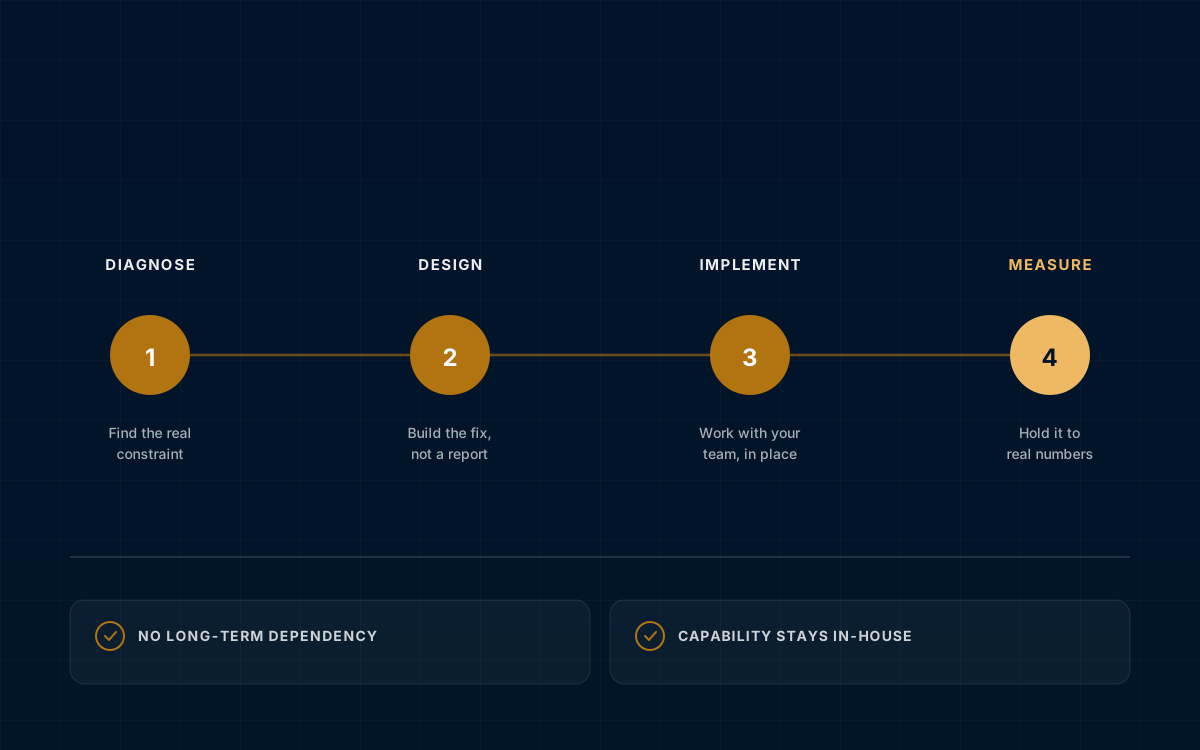
Discovery → Diagnosis → Priorities → Recommendations → Implementation → Measurement → Adjustment
That progression turns an assessment into a performance-improvement process.
The Engagement Should Produce More Than a Report
A report can document findings.
A plan can identify what should happen next.
But meaningful performance improvement requires execution.
Management should therefore understand whether the engagement is designed to:
- Identify issues
- Establish priorities
- Develop solutions
- Implement changes
- Establish accountability
- Measure results
- Adjust the approach as necessary
The appropriate level of involvement depends on the organization's needs and the scope of the engagement.
The Final Test
Before engaging an outside sales-performance resource, management should be able to understand:
- What will be examined.
- How the assessment will be conducted.
- What will be delivered.
- What implementation is included.
- What is not included.
- How the fee is determined.
- How long the engagement will last.
- How progress will be measured.
- What happens when the initial engagement ends.
The objective is not to find a consultant who promises the biggest result.
It is to find an outside resource whose scope, approach, experience, and level of involvement match the problem the company actually needs to solve.
NORTH POINT SALES GROUP approaches sales-performance improvement as an examination of the organization as a whole—followed by focused implementation of the changes that can have the greatest practical impact.
Learn how a NORTH POINT SALES GROUP engagement works.