

Sales Training Isn't the Same as Sales Performance Improvement
Sales-performance insights for owners and executives who want to understand what is really limiting growth.
Sales training has a legitimate place in a sales organization.
Salespeople need knowledge, skills, practice, and ongoing development.
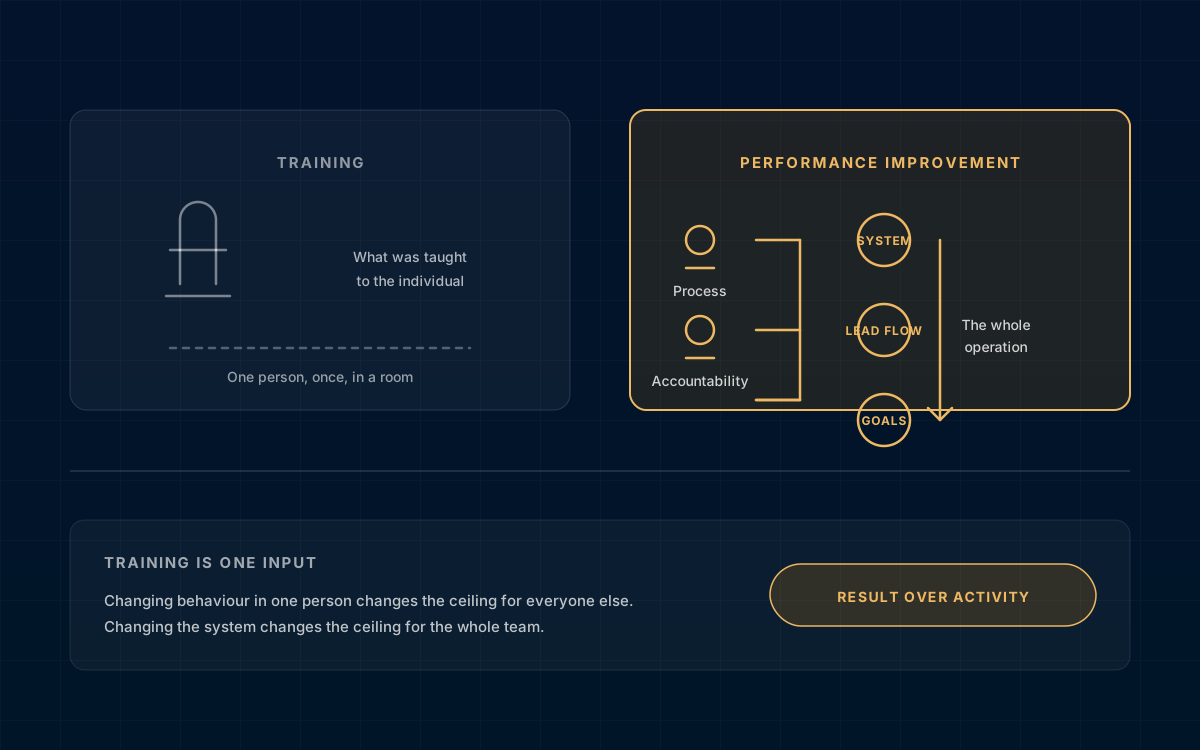
But sales training and sales-performance improvement are not the same thing.
A company can provide excellent sales training and still have a sales-performance problem.
That is because sales performance is influenced by much more than what a salesperson knows.
Training Can Improve Capability. Performance Involves the System.
Training can help a salesperson improve:
- Prospecting skills
- Sales conversations
- Presentations
- Qualification
- Negotiation
- Closing techniques
- Product knowledge
Those skills matter.
But consider what happens when the salesperson returns to an organization with:
- An unclear sales process
- Weak lead generation
- Poor pipeline management
- Inconsistent sales management
- Little accountability
- An ineffective CRM
- Unclear performance expectations
- Compensation that does not reinforce desired behavior
The salesperson may have better skills.
The organization may still have the same performance problem.
Sales Performance Is Multi-Dimensional
Effective sales performance can involve numerous connected areas:
- Sales leadership
- Sales systems and processes
- Team performance
- Prospecting and lead development
- Sales presentations
- Pipeline management
- CRM utilization
- Performance measurement
- Compensation and incentives
- Recruiting and onboarding
- Retention and development
- Training
The right areas to examine will vary by organization.
The important point is that training is one component of sales performance—not the entire system.
This broader view is consistent with how established sales-performance firms describe their work: diagnostics can span strategy, process, human performance, management, technology, and implementation rather than focusing exclusively on classroom training. (Performance Methods, Inc)
When Training Is the Right Answer
Sometimes training really is the answer.
If a sales team understands the company's process but lacks specific skills, targeted training may produce meaningful improvement.
If new salespeople need to learn products, markets, systems, or selling practices, training is essential.
If a specific performance gap has been identified as a knowledge or skill issue, training should be part of the solution.
The problem occurs when training is used as the default response to every sales-performance problem.
What Happens When Training Isn't the Real Problem?
Suppose the real issue is poor lead quality.
Training the salespeople to sell better does not improve the quality of the leads.
Suppose the real issue is inconsistent follow-up.
Training may help, but if there is no management accountability, the behavior may not change.
Suppose the sales process itself is inefficient.
Teaching salespeople to work harder within that process does not eliminate the inefficiency.
Suppose the CRM does not provide management with accurate pipeline information.
Another sales-training program will not fix the CRM.
This is why diagnosis matters.
Performance Improvement Starts With the Question: Why?
Rather than immediately asking:
“What training do our salespeople need?”
management should first ask:
“Why are we not getting the sales performance we should be getting?”
That question opens the door to a much broader examination.
Perhaps training is needed.
Perhaps management needs improvement.
Perhaps the sales process needs to change.
Perhaps lead generation is inadequate.
Perhaps accountability is weak.
Perhaps individual salespeople need direct performance work.
Perhaps several of these issues are connected.
The answer should be based on evidence rather than assumption.
The Objective Is Not to Eliminate Training
Sales training remains an important part of a strong sales organization.
The objective is to put training in its proper place.
If the organization needs training, provide it.
If it needs process improvement, improve the process.
If it needs stronger sales management, address management.
If it needs better lead generation, address lead generation.
If individual performance needs attention, address individual performance.
And when several areas are affecting results, address the areas that have the greatest potential impact.
Sales Performance Is About Execution
Ultimately, sales performance is determined by what happens in the real sales environment.
What are salespeople actually doing?
What opportunities are entering the organization?
How are those opportunities being handled?
How are managers managing performance?
Where are opportunities being lost?
What does the data show?
What happens after a recommendation is made?
That last question is particularly important.
A recommendation has no business value until someone puts it into operation.
Sales training can develop capability. Sales-performance improvement is about making the entire sales organization perform more effectively.
Those are related objectives, but they are not the same engagement.
NORTH POINT SALES GROUP does not begin with the assumption that training is the answer. The organization is examined first, and training is applied where the diagnosis indicates it is needed.
Learn how a NORTH POINT SALES GROUP engagement works.