

Is Your Sales Team Really the Problem?
Sales-performance insights for owners and executives who want to understand what is really limiting growth.
When sales are below expectations, the sales team is often the first place management looks.
The reasoning is understandable. Salespeople generate sales, so if sales are not where they should be, perhaps the salespeople are the problem.
Sometimes they are.
But salesperson performance is only one part of the equation. Sales results can be influenced by the entire environment in which salespeople operate—including leadership, processes, lead generation, technology, compensation, accountability, training, and the quality of opportunities entering the pipeline.
Before replacing people, adding people, or sending people to another sales-training program, it is worth determining what is actually limiting performance.
Salespeople Can Only Perform Within the System Around Them
Consider a salesperson who is expected to produce more business but receives inconsistent leads.
Or a salesperson who generates opportunities but operates within a sales process that has no clear stages, definitions, or expectations.
Or a salesperson who has a healthy pipeline but receives little coaching or accountability from management.
Or a salesperson who spends substantial time on activities that do not contribute meaningfully to revenue.
In each case, the salesperson may appear to be underperforming.
But the underlying problem may exist somewhere else.
This is why simply looking at sales numbers does not necessarily identify the cause of the problem.
There Are Multiple Factors Behind Sales Performance
A sales organization can be affected by numerous interconnected factors, including:
- Sales leadership and management
- Sales processes and procedures
- Prospecting and lead development
- Sales presentations and conversations
- Pipeline management
- CRM utilization
- Performance measurement
- Compensation and incentives
- Recruiting and onboarding
- Training and development
- Customer retention and development
- Individual and team performance
These areas do not operate independently.
A weakness in one area can affect performance somewhere else.
Poor pipeline management, for example, can make forecasting unreliable. Poor forecasting can affect management decisions. Weak management visibility can make accountability difficult. Inadequate accountability can allow performance problems to continue.
The salesperson may be showing the symptom without being the primary cause.
What Should Management Ask?
Instead of asking only, “Which salespeople are underperforming?”, management should also ask:
- Where are we losing opportunities?
- Are our salespeople spending their time effectively?
- Are qualified opportunities being generated in sufficient numbers?
- Are leads being handled quickly and appropriately?
- Is our sales process producing consistent execution?
- Are sales managers actively managing performance?
- Do we have reliable pipeline and forecasting information?
- Are our performance expectations clear and measurable?
- Are our compensation and incentive systems reinforcing the behavior we want?
- Is our CRM providing useful management information or simply storing data?
These questions provide a much more complete picture.
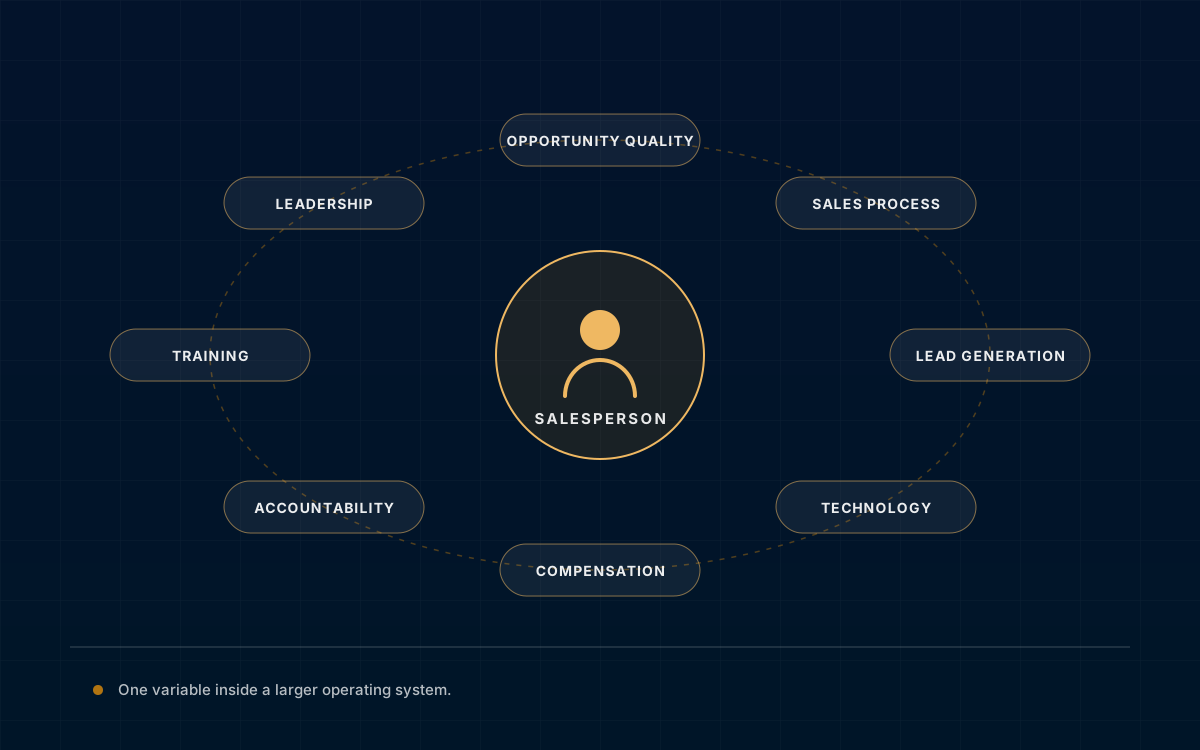
Don't Assume the Salespeople Are the Problem
This does not mean salespeople should never be held accountable.
They should.
Individual performance matters, and some salespeople will inevitably perform better than others.
The point is that individual accountability should be based on an accurate understanding of the environment in which those individuals are expected to perform.
If the underlying sales operation is creating unnecessary obstacles, replacing salespeople may simply replace one set of problems with another.
Likewise, hiring additional salespeople may increase payroll without solving the underlying performance issue.
Diagnose Before You Prescribe
A professional sales-performance evaluation should determine what is actually limiting the organization's ability to produce sales before recommending major changes.
That means looking beyond individual sales numbers and examining the sales operation as a whole.
The goal is not to find someone to blame.
The goal is to determine what needs to change.
Once the actual constraints are identified, management can make better decisions about whether the appropriate response is improved management, process changes, additional training, technology changes, stronger accountability, individual performance work, additional sales capacity—or some combination of these.
The More Important Question
The most useful question may not be:
“Are our salespeople performing well enough?”
It may be:
“Is our sales organization performing as effectively as it reasonably can?”
That question changes the discussion from blaming individuals to understanding the entire sales-performance system.
And that is where meaningful improvement begins.
NORTH POINT SALES GROUP examines the sales organization as a whole to identify where performance may be constrained and where meaningful improvement opportunities may exist.
Learn how a NORTH POINT SALES GROUP engagement works.