

How Much Additional Sales Are You Leaving on the Table?
Sales-performance insights for owners and executives who want to understand what is really limiting growth.
Most companies know what they sold last year.
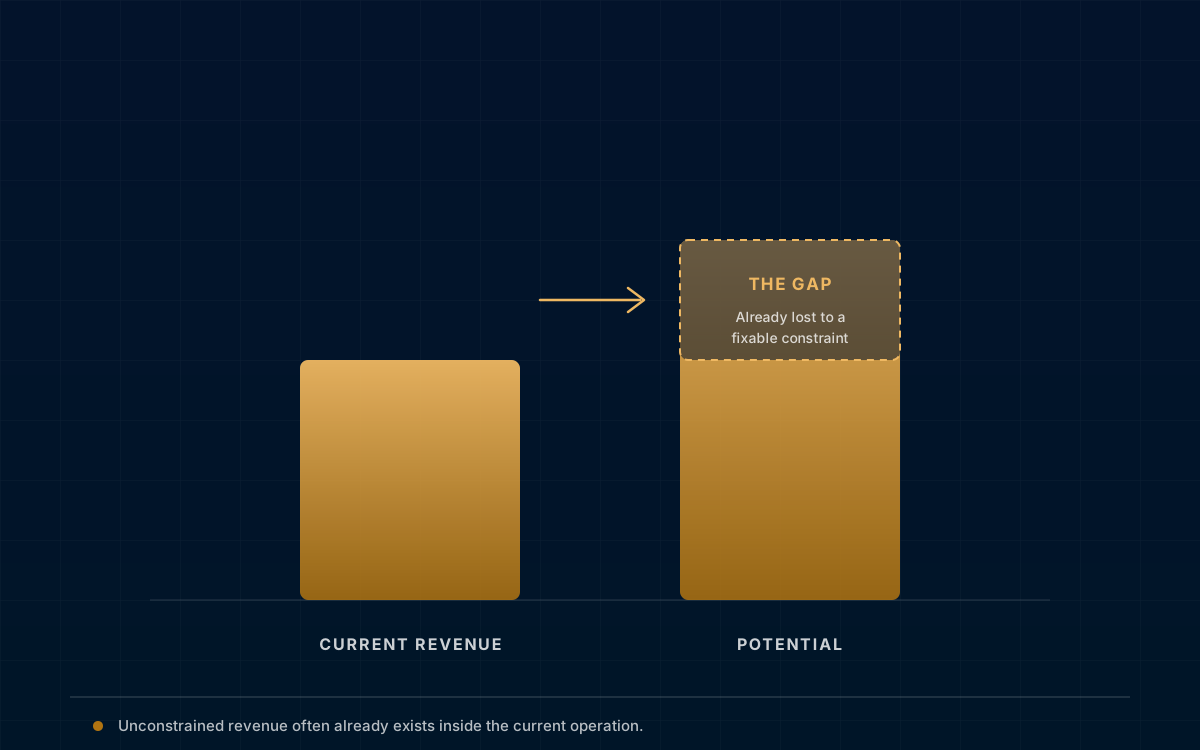
Far fewer have determined how much additional sales capacity may exist within their current organization.
That capacity is not a guaranteed number, and it cannot be determined simply by looking at a company's revenue.
But it is a question worth examining.
Sales Capacity Is More Than the Number of Salespeople
A company may have ten salespeople and assume it has the capacity of ten salespeople.
That is not necessarily true.
Capacity is affected by how effectively those people are being used.
If salespeople spend significant time on low-value activities, fail to follow up consistently, work poorly qualified opportunities, or operate without effective management and accountability, some of their potential production may never become revenue.
The same applies to the sales organization around them.
A weak process can reduce capacity.
Poor lead generation can reduce capacity.
Weak pipeline management can reduce capacity.
Inadequate management can reduce capacity.
A Small Improvement Can Have a Large Financial Effect
Consider a company generating $20 million in annual sales.
A 5% improvement in sales would represent approximately $1 million in additional annual sales.
At 10%, it would represent approximately $2 million.
At 15%, approximately $3 million.
These examples are not predictions. They simply illustrate why relatively modest improvements in sales effectiveness can have substantial financial consequences.
The more important question is whether the organization has the underlying conditions that make improvement possible.
Where Can Untapped Capacity Exist?
Untapped capacity can occur at almost every stage of the sales process.
Prospecting
Are salespeople generating enough qualified opportunities?
Qualification
Are salespeople spending time on prospects that have a reasonable potential to become customers?
Presentations
Are sales conversations effectively communicating value and addressing the prospect's actual needs?
Follow-Up
Are qualified opportunities receiving appropriate and timely follow-up?
Pipeline Management
Does management know which opportunities are real, which are stalled, and which should no longer be in the pipeline?
Sales Management
Are managers actively managing performance, or primarily reviewing numbers after the fact?
CRM
Does the CRM provide useful information for managing sales, or is it primarily being used as a record-keeping system?
Accountability
Do salespeople and managers know what performance is expected and how it will be measured?
Each of these areas can affect the amount of sales an organization is capable of producing.
Revenue Is Not the Only Measure
Additional sales are important, but revenue alone does not tell the complete financial story.
The more useful question is:
What additional profit contribution can those sales produce after the direct costs associated with producing and delivering them?
That number provides management with a much better basis for determining whether an investment in sales-performance improvement makes financial sense.
If an organization can generate significant additional sales without proportionately increasing its direct costs, the resulting contribution can be substantial.
Don't Start With the Percentage
It can be tempting to begin with a desired improvement—5%, 10%, 20%, or more.
That is the wrong starting point.
The starting point should be an examination of the organization.
What is working?
Where are opportunities being lost?
Where is capacity being wasted?
What is preventing salespeople from producing more?
Which changes could reasonably improve performance?
Only after those questions have been examined can management make a meaningful judgment about the potential opportunity.
What Is the Opportunity Worth?
A sales-performance assessment should ultimately help management understand three things:
- Where are we now?
- What could reasonably be improved?
- What would that improvement be worth to the business?
That allows the company to compare the potential financial benefit with the cost of making the necessary changes.
The objective is not to promise a percentage increase.
It is to identify whether meaningful additional sales capacity appears to exist and determine what would be required to capture it.
The Opportunity May Already Be Inside the Organization
Companies often look outside themselves for growth.
Sometimes the opportunity is already inside the sales organization.
The question is whether the company has identified where that opportunity exists and whether it is prepared to do something about it.
That is a much more useful question than simply asking whether the sales team needs to sell more.
NORTH POINT SALES GROUP focuses first on identifying where additional sales capacity may exist and what would be required to capture it.
Learn how a NORTH POINT SALES GROUP engagement works.